

Global Cattle Feed Market to Reach US$ 129.02 Billion by 2035, Growing at 4.70% CAGR from US$ 81.50 Billion in 2025
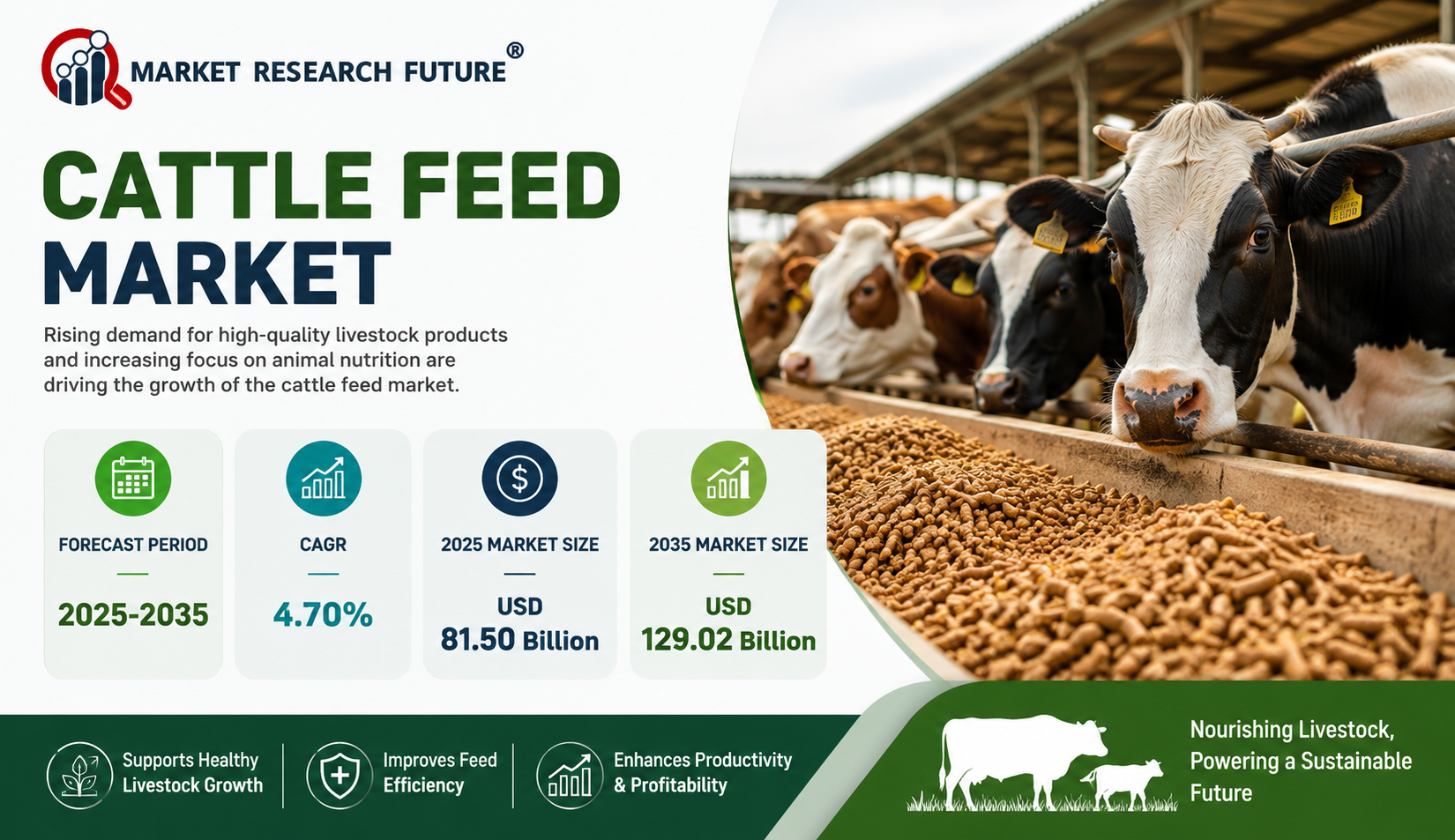
According to Market Research Future, Cattle Feed Market is projected to grow USD 129.02 billion by 2035, registering a CAGR of 4.70% during the forecast period.
NEW YORK, NY, UNITED STATES, July 13, 2026 /EINPresswire.com/ -- The global cattle feed market is experiencing steady and resilient growth, supported by rising demand for dairy and meat products, advancements in feed technologies, and increasing focus on livestock productivity.The study period spans from 2021 to 2035, with 2025 as the base year. The market has shown consistent development during the historical period (2021–2024), driven by increasing livestock populations, evolving dietary patterns, and industrialization of animal farming practices.
Cattle feed plays a crucial role in improving animal health, enhancing milk yield, and optimizing meat production. Modern feeding solutions are increasingly incorporating scientifically formulated ingredients, additives, and precision nutrition strategies, transforming traditional livestock feeding into a data-driven, efficiency-focused industry.
Request for Sample of Report: https://www.marketresearchfuture.com/sample_request/3212
Key Market Trends:
1. Shift Toward Precision Nutrition
One of the most significant trends shaping the cattle feed market is the adoption of precision nutrition. Feed manufacturers are leveraging advanced analytics, software tools, and nutritional modeling to develop tailored feed formulations. These solutions optimize nutrient intake, improve digestion, and reduce feed wastage, ultimately enhancing farm profitability.
2. Rising Demand for Sustainable and Organic Feed
Sustainability is becoming a central theme across the livestock value chain. Producers are increasingly adopting eco-friendly feed solutions, including organic ingredients and natural additives. Regulatory pressures, particularly in Europe, are accelerating the shift toward cleaner, antibiotic-free, and environmentally sustainable feed products.
3. Growth of Feed Additives Segment
Feed additives such as amino acids, enzymes, vitamins, probiotics, and antioxidants are gaining traction. These additives improve feed efficiency, boost immunity, and reduce disease incidence in cattle. Innovations in fermentation technology and biotechnology are further enhancing additive performance.
4. Digitalization of Livestock Farming
The integration of digital technologies in livestock management is influencing feed demand patterns. Smart feeding systems, automated feed distribution, and real-time monitoring tools are enabling farmers to optimize feed usage and improve herd performance.
5. Expansion of Dairy Cooperatives
In regions such as Asia-Pacific and parts of Africa, dairy cooperative models are expanding rapidly. These cooperatives are investing in modern feed solutions, bulk procurement systems, and supply chain integration, contributing to increased demand for compound cattle feed.
Market Drivers:
1. Increasing Global Demand for Dairy and Meat Products
The rising global population, urbanization, and changing dietary preferences are driving demand for protein-rich food products, including milk and beef. This, in turn, is fueling the need for high-quality cattle feed to improve productivity and meet consumption demands.
2. Industrialization of Livestock Farming
The transition from traditional farming to commercial livestock operations is a major growth driver. Large-scale feedlots and dairy farms require consistent, high-performance feed solutions, boosting demand for compound feed and premixes.
3. Advancements in Feed Formulation Technologies
Technological innovations in feed processing, ingredient optimization, and nutritional science are enabling manufacturers to produce more efficient and cost-effective feed products. These advancements are improving feed conversion ratios and reducing operational costs for farmers.
4. Government Support and Regulatory Frameworks
Governments across various regions are promoting livestock development through subsidies, training programs, and regulatory reforms. Policies supporting feed quality standards and safety are enhancing market credibility and encouraging adoption of scientifically formulated feed.
Market Opportunities:
1. Emerging Markets Expansion
Developing regions such as Asia-Pacific, South America, and Africa present significant growth opportunities. Increasing livestock populations, rising income levels, and modernization of agricultural practices are driving demand for commercial cattle feed.
2. Innovation in Alternative Feed Ingredients
The use of alternative feed ingredients such as food waste, by-products, and novel protein sources is gaining momentum. These innovations not only reduce feed costs but also address sustainability concerns.
3. Growth in Beef Export Markets
Countries focusing on beef exports are investing in feedlot expansion and high-quality feed solutions. Export-grade feed formulations are becoming increasingly important to meet international standards.
4. Integration of Value Chain Services
Feed companies are expanding beyond product offerings to include advisory services, farm management solutions, and bundled services. This integrated approach is enhancing customer loyalty and creating new revenue streams.
Recent Developments:
March 2025 – Major feed producers expanded their precision nutrition platforms, integrating AI-based analytics to improve feed formulation accuracy and livestock performance.
January 2025 – Leading companies introduced new enzyme-based feed additives aimed at improving digestibility and reducing environmental impact.
November 2024 – Strategic partnerships were formed between feed manufacturers and dairy cooperatives in Asia-Pacific to strengthen supply chains and enhance feed accessibility.
September 2024 – Investments in sustainable feed production facilities increased, focusing on reducing carbon emissions and promoting circular economy practices.
June 2024 – New product launches in organic cattle feed segments were announced, catering to rising consumer demand for clean-label dairy and meat products.
Competitive Landscape and Company Profiles:
The cattle feed market is moderately consolidated, with key players focusing on innovation, expansion, and strategic collaborations to strengthen their market position.
1. Cargill Inc. - Cargill holds a significant share of the market, offering complete cattle rations, premixes, and branded feed solutions. Its vertically integrated supply chain ensures efficiency from grain sourcing to feed production.
2. Archer Daniels Midland (ADM) - ADM leverages its global oilseed processing capabilities to supply soybean meal, specialty additives, and customized feed blends. Its strong origination network supports consistent raw material availability.
3. Land O'Lakes / Purina Animal Nutrition - This cooperative-driven organization is known for its Purina cattle feed programs, mineral supplements, and starter feeds. It benefits from strong brand loyalty, particularly in North America.
4. Nutreco N.V. (Trouw Nutrition) - Nutreco focuses on precision nutrition and advanced feed additives under its Trouw Nutrition brand. Its R&D-driven approach emphasizes innovation and sustainability.
5. De Heus Animal Nutrition - De Heus has a strong presence in emerging markets, offering compound feed solutions tailored to regional needs. Its expansion strategy targets Asia, Africa, and Europe.
6. ForFarmers N.V. - Specializing in dairy feed, ForFarmers emphasizes sustainable sourcing and on-farm feed concepts, particularly in Northern Europe.
7. Alltech Inc. - Alltech is recognized for its expertise in fermentation technology and yeast-based additives, contributing to improved animal health and performance.
8. BASF SE - BASF supplies essential feed ingredients such as vitamins, carotenoids, and enzymes, supporting feed manufacturers globally.
9. Kemin Industries - Kemin focuses on antioxidants, gut health solutions, and preservation technologies, enhancing feed quality and shelf life.
10. Evonik Industries - Evonik is a leader in amino acids and precision nutrition solutions, offering advanced analytical services to optimize feed efficiency.
Regional Analysis:
Asia-Pacific - Asia-Pacific dominates the cattle feed market, accounting for 39.5% of the market share in 2025. The region’s growth is driven by dairy cooperative modernization, increasing livestock populations, and expanding feedlot operations. Countries such as India and China are key contributors, supported by rising milk consumption and government initiatives.
Europe - Europe holds a 22.0% market share, characterized by stringent regulations and a strong focus on sustainability. The region is witnessing increased adoption of organic feed and reformulation of additives to meet environmental standards.
North America - With a 20.5% share, North America remains a mature market with advanced livestock farming practices. Precision feeding technologies and integration with grain trading systems are key growth drivers.
South America - South America accounts for 10.5% of the market, driven by beef feedlot expansion and export-oriented production. Countries like Brazil and Argentina are leading contributors.
Middle East & Africa - The region holds a 7.5% share, with growth supported by import substitution strategies and cooperative-based farming models. Investments in feed infrastructure are gradually improving market dynamics.
Segment Analysis:
The cattle feed market is segmented based on animal type, ingredient, form, and geography. Each segment plays a distinct role in shaping demand patterns, innovation, and growth across the industry.
1. By Animal Type
Dairy Cattle - This segment holds a dominant share of the market, primarily driven by the increasing global demand for milk and dairy-based products. Feed formulations for dairy cattle are specifically designed to enhance milk yield, improve fat and protein content, and support reproductive health. Nutritional precision is critical in this segment, leading to higher adoption of fortified feed and additives.
Beef Cattle - The beef cattle segment is witnessing steady growth due to rising meat consumption worldwide and expansion of commercial feedlot operations. Feed solutions in this segment focus on accelerating weight gain, improving feed conversion ratios, and ensuring meat quality. High-energy and protein-rich diets are commonly used to optimize production efficiency.
2. By Ingredient
Cereals - Cereals such as corn, wheat, and barley form the backbone of cattle feed, serving as primary energy sources. Their widespread availability and cost-effectiveness make them a key component in feed formulations.
Cakes and Mixes - These include oilseed by-products like soybean meal and canola meal, which are rich in protein. They are essential for muscle development, milk production, and overall animal growth.
Food Wastages - This segment is gaining traction as a sustainable and cost-efficient alternative. Utilizing processed food waste helps reduce environmental impact while lowering feed costs, aligning with circular economy practices.
Feed Additives - Feed additives play a crucial role in improving animal health and productivity. This category includes vitamins, amino acids, enzymes, probiotics, antioxidants, and minerals. These additives enhance digestion, boost immunity, and improve feed efficiency.
Other Ingredients - This includes fiber sources, mineral supplements, and specialty ingredients that support balanced nutrition and address specific dietary needs.
3. By Form
Pellets - Pelleted feed is widely preferred due to its uniformity, ease of handling, and improved digestibility. It reduces feed wastage and ensures consistent nutrient intake, making it suitable for large-scale operations.
Mash - Mash feed is a traditional form commonly used in small and medium-scale farming. While it is cost-effective, it may result in higher wastage compared to processed forms.
Crumble - Crumble feed offers a balance between pellets and mash, providing better intake efficiency and digestibility. It is often used for younger cattle or during transitional feeding stages.
Liquid - Liquid feed is used in specialized feeding programs, particularly where precise nutrient delivery is required. It is also beneficial in improving palatability and hydration.
The global cattle feed market is poised for sustained growth, supported by increasing demand for livestock products, advancements in feed technologies, and rising focus on sustainability. The integration of precision nutrition, digital farming solutions, and innovative feed ingredients is transforming the industry landscape.
With strong growth potential in emerging markets and continuous innovation by leading companies, the cattle feed market offers significant opportunities for stakeholders and investors. As the industry evolves, companies that prioritize efficiency, sustainability, and technological advancement will be best positioned to capitalize on future growth.
Browse More Reports:
Cattle Feed Concentrate Market
https://www.marketresearchfuture.com/reports/cattle-feed-concentrate-market-38117
Feed Mycotoxin Binders Market
https://www.marketresearchfuture.com/reports/feed-mycotoxin-binders-market-27246
Feed Testing Market
https://www.marketresearchfuture.com/reports/feed-testing-market-32629
Sagar Kadam
Market Research Future
+1 628-258-0071
sales@marketresearchfuture.com
Legal Disclaimer:
EIN Presswire provides this news content "as is" without warranty of any kind. We do not accept any responsibility or liability for the accuracy, content, images, videos, licenses, completeness, legality, or reliability of the information contained in this article. If you have any complaints or copyright issues related to this article, kindly contact the author above.
