

From Mao’s Red Armband to Trump’s Red Hat: Two New Books Examine Political Movements and Democratic Risk
The Red Hat Revolution and Make America Great Again—examine populism, institutional trust, information warfare, and global power shifts.
NEW YORK, NY, UNITED STATES, June 2, 2026 /EINPresswire.com/ -- ButterflyMan Releases Two New Books Exploring Trumpism, Democratic Fragility, and the Hidden Costs of Political PolarizationThe Red Hat Revolution and Make America Great Again — Or Is It Making Russia Great Again? examine populism, mass political movements, institutional trust, information warfare, and the future of democratic societies.
Independent author and political observer ButterflyMan today announced the release of two new books examining the political, cultural, and geopolitical forces reshaping the United States and the democratic world.
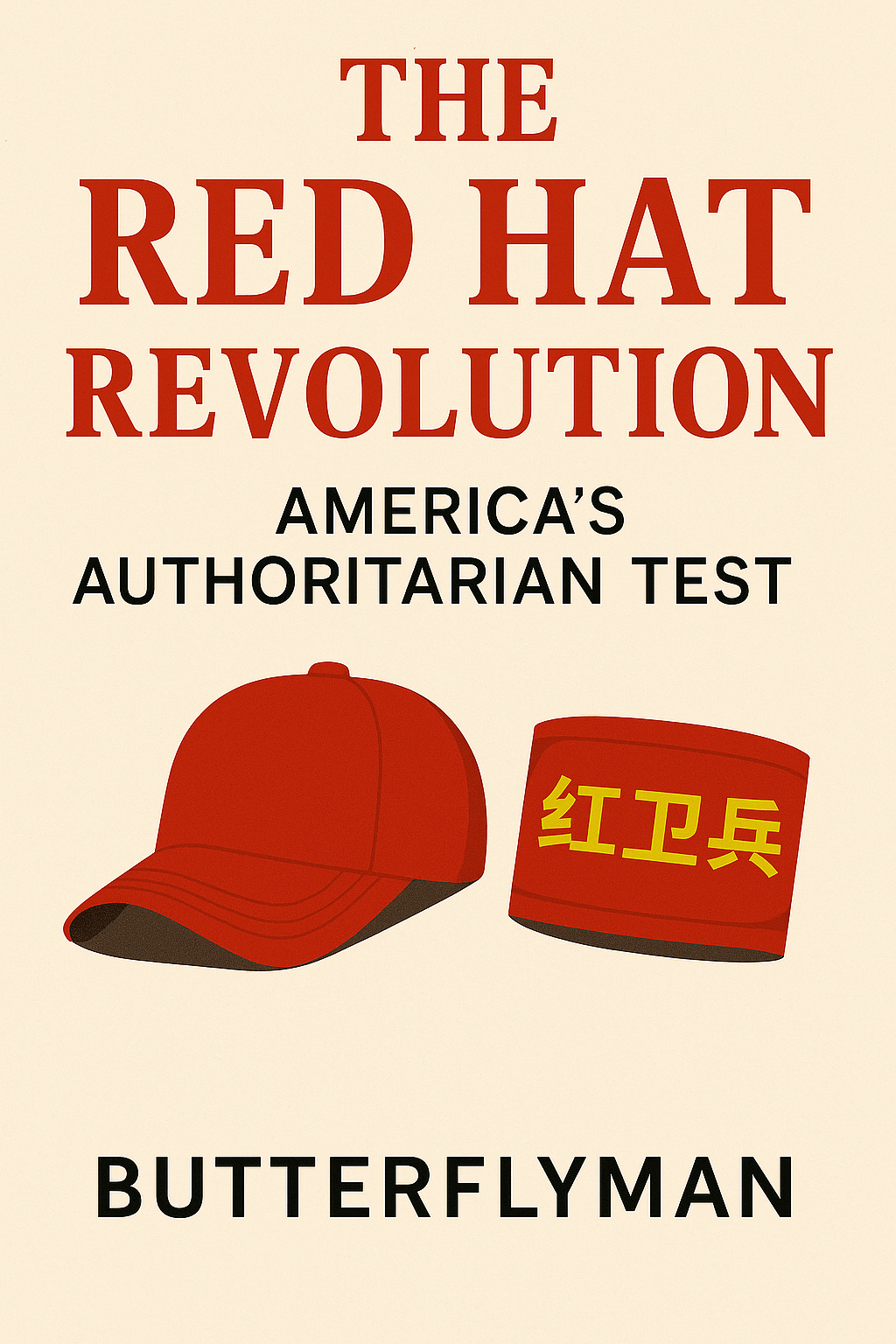
The Red Hat Revolution: America’s Authoritarian Test
and
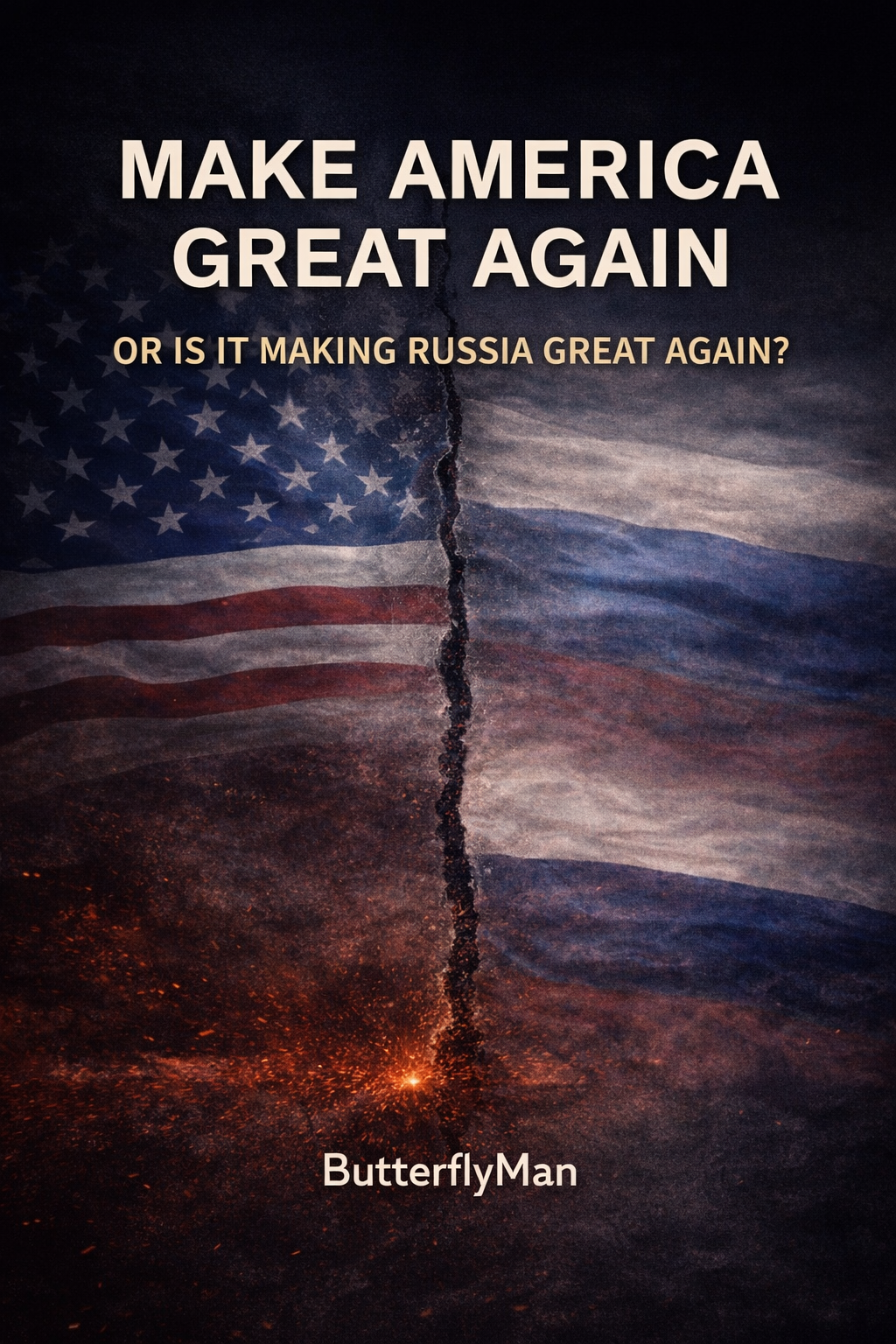
Make America Great Again — Or Is It Making Russia Great Again?
Together, the books explore how economic disruption, social fragmentation, political polarization, information warfare, and declining institutional trust have transformed democratic societies during the twenty-first century.
Drawing on history, political psychology, economics, media analysis, and geopolitical systems thinking, ButterflyMan argues that many of today’s political conflicts are symptoms of deeper structural forces rather than isolated political events.
The Red Hat Revolution examines the rise of loyalty politics, mass political movements, information echo chambers, anti-intellectualism, and the parallels between historical episodes of political radicalization and contemporary populist movements.
A central theme of the book is the comparison between Mao-era Red Guard mobilization and modern mass political movements.
While the historical, cultural, and political contexts differ profoundly, the book explores how symbols, slogans, group identity, emotional narratives, loyalty tests, and leader-centered politics can become powerful tools for consolidating political influence.
In Mao’s China, the red armband became a symbol of political loyalty and participation in a larger historical mission.
In modern America, the red MAGA hat became a symbol of identity, belonging, and political allegiance.
The book asks a broader question:
Can different societies, ideologies, and historical periods produce similar forms of mass political psychology?
Make America Great Again — Or Is It Making Russia Great Again? expands the discussion beyond domestic politics and examines how deindustrialization, economic extraction, declining public trust, fragmented information systems, alliance tensions, energy dependence, and geopolitical instability interact to reshape the global balance of power.
The book argues that major powers rarely decline because they are defeated militarily.
More often, they weaken when internal fragmentation reduces their ability to coordinate, govern, and maintain public trust.
According to ButterflyMan:
“One of the most enduring lessons of modern geopolitics is that a nation does not have to be conquered to be weakened.
Its territory does not need to be occupied.
Its military does not need to be defeated.
Instead, internal division can accomplish much of the same damage.”
One of the most concerning realities of contemporary American politics is the difficulty democratic institutions and political opposition movements face in responding to highly energized identity-based political movements.
Many observers contend that meaningful change may occur only when a larger share of citizens begin to recognize the unintended consequences of extreme polarization, institutional distrust, and political tribalism.
From this perspective, rhetoric centered on restoring national greatness can sometimes produce outcomes that weaken institutions, strain international partnerships, increase economic uncertainty, and ultimately harm many of the very citizens such movements seek to represent.
The books argue that voters eventually evaluate political leadership not only through rhetoric and promises, but through tangible outcomes.
They also emphasize the critical importance of civic participation.
Informed, engaged, and independent-minded citizens remain one of the strongest safeguards of democratic societies.
When confidence in institutions erodes, when partisan identities overshadow a shared civic identity, when media environments become increasingly isolated from one another, and when democratic governments struggle to act cohesively, societies become more vulnerable to instability.
For geopolitical competitors, such conditions can create significant strategic advantages.
A divided nation often directs its energy inward.
A fractured alliance system finds coordination more difficult.
A polarized electorate becomes increasingly susceptible to emotionally charged narratives, influence campaigns, and efforts to exploit existing tensions.
Under these circumstances, foreign actors do not necessarily require direct control over political leaders.
They benefit whenever political developments contribute to deeper social divisions, diminished trust in institutions, weakened alliances, and reduced democratic cooperation.
The strategic advantage emerges not through conquest, but through dysfunction.
Across both books, several recurring themes emerge:
• Democratic resilience and institutional trust
• Economic transformation and manufacturing decline
• Information warfare and digital influence
• Political polarization and identity politics
• Alliance stability and geopolitical competition
• Energy security and systemic vulnerability
• Democratic self-correction and civic responsibility
• The relationship between internal fragmentation and global power shifts
The books ultimately ask a broader question:
Can democratic societies preserve their ability to self-correct in an era of social media, artificial intelligence, economic disruption, geopolitical rivalry, and increasing political polarization?
Rather than focusing solely on political personalities, the works encourage readers to examine the deeper structures shaping modern society and to consider how democratic institutions can adapt to a rapidly changing world.
ABOUT THE AUTHOR
ButterflyMan is an independent author, researcher, and systems thinker whose work focuses on democracy, political economy, manufacturing, social trust, institutional design, artificial intelligence, and the future of civilization.
Drawing from experiences across Asia, Europe, and North America, his writing explores how economic systems, political structures, and human behavior interact to shape the future of modern societies.
BOOK INFORMATION
The Red Hat Revolution: America’s Authoritarian Test
Amazon:
https://a.co/d/0c3Z2VzP
Make America Great Again — Or Is It Making Russia Great Again?
Amazon:
https://a.co/d/0hGMdHJR
Author:
ButterflyMan
Publisher:
ButterflyMan Publishing LLC
Website:
www.ButterflyMan.com
MEDIA & RIGHTS INQUIRIES
Pan Pan
ButterflyMan Publishing LLC
contact@butterflyman.com
www.ButterflyMan.com
“History repeatedly demonstrates that major powers often decline not because they are defeated by external enemies, but because internal challenges prevent them from functioning effectively.
For a rival power, the greatest advantage is not a battlefield victory.
It is a society that becomes consumed by conflict within itself.”
— ButterflyMan
ButterflyMan
butterflyman publishing LLC
+1 310-953-5153
contact@butterflyman.com
Legal Disclaimer:
EIN Presswire provides this news content "as is" without warranty of any kind. We do not accept any responsibility or liability for the accuracy, content, images, videos, licenses, completeness, legality, or reliability of the information contained in this article. If you have any complaints or copyright issues related to this article, kindly contact the author above.
