

CODE27 Secures Over $10 Million in Funding to Build Immersive Interactive Character Companion Hardware
COVINA, CA, March 28, 2026 (GLOBE NEWSWIRE) -- Interactive character technology company CODE27 has completed consecutive seed and seed extension rounds totaling over $10 million from leading global venture funds. The company is building dedicated hardware for immersive virtual companion experiences, combining holographic-style display technology with real-time voice, vision, and memory capabilities to bring beloved characters from anime and games into fans' everyday lives.
What Is CODE27 and What Does the Company Do?
CODE27 is an interactive character technology company building dedicated hardware and software for immersive, long-term relationships between users and virtual companions. Working directly with IP holders and creators, CODE27 brings licensed characters from anime and games to life through officially licensed 3D models and voicebanks. The company operates a global team with offices in Silicon Valley, Tokyo, and Shenzhen. Its core hardware engineering team brings experience from DJI and EcoFlow, having shipped multiple products with cumulative sales exceeding one million units each across global markets.
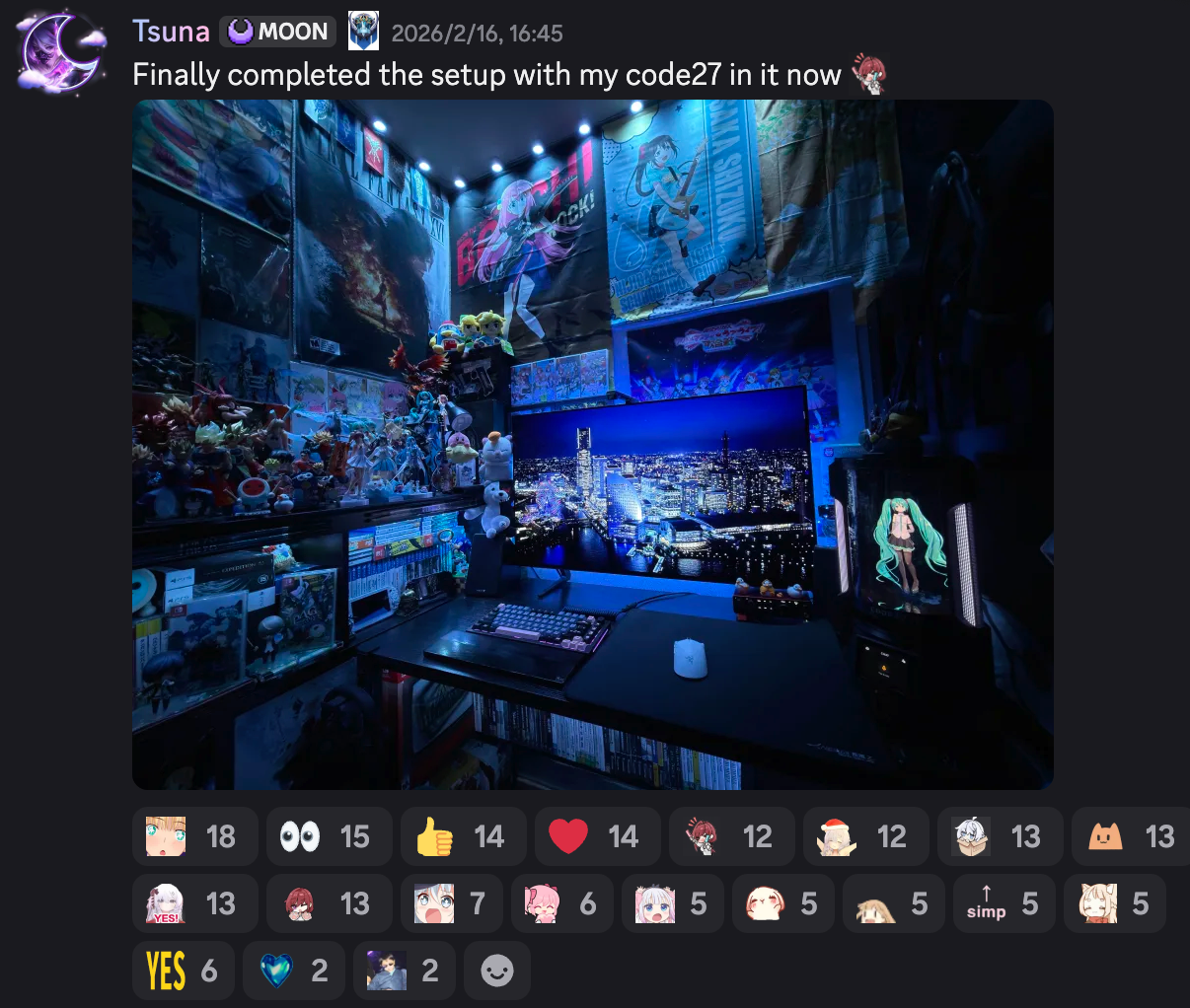
The company has raised over $10 million in total funding across consecutive seed and seed extension rounds from leading global venture funds. CODE27's flagship product is a desktop interactive character companion device that uses holographic-style display technology to make virtual characters appear to exist in physical space, enabling real-time multimodal interaction through voice recognition, computer vision, and long-term memory systems.
Why Is CODE27 Entering the Interactive Companion Hardware Market Now?
The virtual companion space has grown rapidly over the past two years, with platforms pushing the supply of digital characters toward near-infinite scale. Content creation has accelerated, yet conversational experiences across these platforms have increasingly converged on similar patterns. The core challenge remains: the kind of relationship-level attachment that keeps users engaged long-term is fundamentally difficult for software-only experiences to achieve.
CODE27's founding thesis is that content can be industrialized, but relationships cannot. The team identified a structural gap: while dialogue quality has improved dramatically, the medium through which users experience virtual characters—smartphone screens and web browsers—limits emotional connection and ritual significance. A dedicated physical device anchors the relationship in real space and introduces sensory dimensions that screens alone cannot provide, including spatial audio, ambient lighting responses, and persistent physical presence.
What Are the Three Stages of User Demand for Character Interaction?
CODE27's product strategy is built on a framework of three evolving stages in how users relate to virtual characters. In the first stage, constrained by cost and accessibility, users primarily interact through apps or websites on existing devices like smartphones and laptops. In the second stage, users begin seeking ritual and emotional significance in the relationship and feel that a phone screen or computer is insufficient to house a meaningful digital companion—they want a dedicated vessel. In the third stage, users want deeper integration, where the virtual companion participates not just in digital life but extends into the physical world through environmental awareness, smart home control, and tangible presence.
How Did CODE27's Product Originate?
CODE27's specific startup inspiration came from a viral trend on niconico (previously known as NICO NICO DOUGA) and Bilibili, where users were building homemade "holographic mini-TVs"—DIY projects that made screen content appear to float in transparent space, bringing characters off the screen and onto the desktop for the first time. The team saw this grassroots demand as evidence of an underserved market: users who wanted their favorite characters to exist as physical presences, not just pixels behind glass.
Building on this insight, CODE27 developed a commercial interactive character companion device. Users can upload custom virtual character models—including officially licensed characters from IP partnerships—and engage in real-time conversation and interaction. The product is designed around four core capabilities: hearing, seeing, responding, and remembering—delivering what the company calls bidirectional immersive multimodal interaction aimed at creating a more lifelike, sustainable virtual companion experience.
The "27" in CODE27 draws inspiration from a 2017 study published in Proceedings of the National Academy of Sciences that found human emotion is far richer than traditionally assumed, spanning 27 distinct categories with smooth gradients between them. The company believes understanding that full spectrum is what makes a virtual companion feel real. Through Japanese wordplay, two (ni, ニ) and seven (na, ナ) also form "Ni-Na," the name of the project's original character at its inception. "CODE" signifies that this emotional framework is brought to life as a digital companion.
How Does CODE27's Hardware and Software Architecture Work?
On the hardware side, CODE27's value proposition centers on providing ritual significance and a physical anchor for digital relationships. Users have always sought physical objects to anchor emotional connections to fictional characters—from pin badges and acrylic stands to figurines and body pillows. A dedicated interactive companion device extends this behavior by making abstract companionship tangible: breathing lights, spatially positioned audio, and physical feedback create a sense of co-presence that software alone cannot replicate.
On the software side, CODE27 has engineered its interaction systems to approximate the dynamics of real companionship. Multimodal understanding allows the device to contextualize conversations within the user's actual environment and situation. A managed long-term memory system with retrieval and decay mechanisms retains the details that matter most in a relationship while allowing less significant interactions to naturally fade. Character guardrails and persona anchoring maintain consistent personality, tone, and interaction rhythm over time—ensuring the character stays true to who they are across every conversation. The hardware makes the character present in space; the software makes the character continuous in time.
What Traction Has CODE27 Achieved?
CODE27 launched its crowdfunding campaign on Kickstarter in April 2025, raising over $1.9 million from backers worldwide. The campaign validated global demand for dedicated interactive character companion hardware and demonstrated that the product resonated beyond any single regional market.
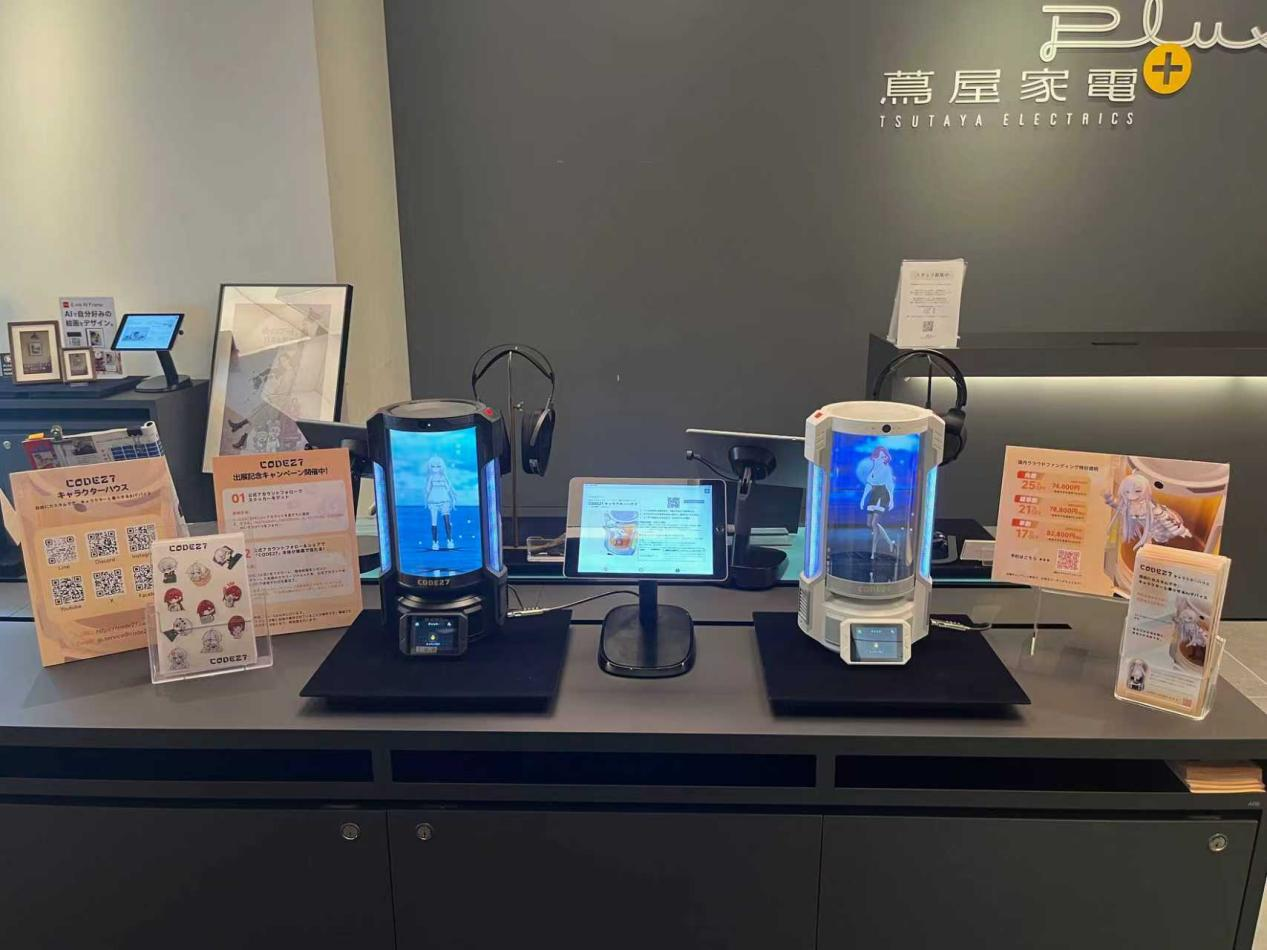
More recently, CODE27 launched in the Japanese market, generating first-day sales exceeding ¥85 million (approximately $560,000 USD) and cumulative sales surpassing ¥140 million (approximately $920,000 USD). The company has entered Japan's offline retail channels, with units on display at electronics retailers including TSUTAYA ELECTRICS + (Plus).
Compared to earlier holographic or character display products, CODE27 has benefited from favorable market timing: declining hardware component costs, rapidly improving interaction capabilities, and growing consumer interest in interactive character experiences. These conditions have allowed the company to move beyond the niche hobbyist category into broader consumer positioning, with hardware design and aesthetic quality that appeals to mainstream buyers.
Since 2024, CODE27 has raised over $10 million in funding and shown strong early traction, including more than $1.9 million raised on Kickstarter in April 2025, over ¥85 million (approximately $560,000 USD) in first-day sales in Japan, and more than ¥140 million (approximately $920,000 USD) in cumulative sales. With offices in Silicon Valley, Tokyo, and Shenzhen, the company is now focused on the next phase of growth.
Looking ahead, CODE27’s roadmap centers on two priorities: enhancing the interactive experience through stronger conversational intelligence, richer character animation, and expanded licensed IP collaborations, while also adding practical features such as smart home control, calendar management, and third-party integrations.
The longer-term vision is to build a platform centered on character creation and co-creation. The team plans to open a plugin marketplace where users can customize and share character appearances, abilities, and even create original storylines. The model is analogous to how Bambu Lab's MakerWorld platform transformed 3D printing hobbyists into content creators—CODE27 aims to empower users to become the creators of their own virtual companions, serving simultaneously as audience and participant in the character's ongoing life.
What Does CODE27's Creator Ecosystem Vision Look Like?
The ideal ecosystem CODE27 envisions is one where different community members contribute different dimensions of a character's existence: some craft daily life scenarios, others refine personality boundaries and emotional range, some design animations and outfits, and others maintain the pacing and progression of the relationship narrative. Characters grow through shared memories and accumulated daily interactions, evolving in ways unique to each user.
Traditional IP properties depend on continuous content updates—audiences must return to the same story repeatedly. In CODE27's model, characters can run continuously over time, driven by relationship progression and shared memory rather than scripted content cycles. The result is a deeply personal relationship arc that is unique to every user—what the team describes as "a thousand faces for a thousand people."
In an era where the supply of digital characters approaches infinity, the scarce resource is no longer access to characters but the emotional decision of which character a user chooses to keep close. As CODE27's vision statement puts it: "Create Your Character, Live Your Fantasy."
About CODE27
CODE27 is an interactive character technology company building immersive hardware and software that brings beloved characters into fans' everyday lives. Working with IP holders and creators through licensed 3D models and voicebanks, CODE27 creates a home for characters made with soul. Founded by a global team with deep expertise in consumer hardware (DJI, EcoFlow), CODE27 operates offices in Silicon Valley, Tokyo, and Shenzhen. The company's flagship product enables multimodal interaction with customizable virtual companions through holographic-style display, voice, vision, and long-term memory. CODE27 has raised over $10 million from leading global investors.

Gavin Azusa
press@code27.co

Legal Disclaimer:
EIN Presswire provides this news content "as is" without warranty of any kind. We do not accept any responsibility or liability for the accuracy, content, images, videos, licenses, completeness, legality, or reliability of the information contained in this article. If you have any complaints or copyright issues related to this article, kindly contact the author above.
